
Settlement of Oregon
In 1834, to encourage settlement of western lands, the U. S. Government passed the Indian Intercourse Act, which provided "the United States shall make indemnification out of the Treasury for property taken or destroyed in certain cases by Indians treaspassing on white men." Between 1840 and 1850, over 11,000 settlers traveled the Oregon Trail.
The Rogue River Indian Wars
During the late 1840s and early 1850s, there were a several "wars" between the native Indians and the settlers. From 1855-1856, there was a major outbreak of violence known as the Rouge River War. (The Rogue River is located in southern Oregon near.)
Three brothers owned a store and hotel in Deer Creek Valley, in Josephine County, Oregon. The firm, E. J. Northcutt and Brothers, was owned by Edward J., Shadrach D., and William W. NORTHCUTT. A fourth brother , Salathiel T., worked at the store but was not an owner. In the early morning hours on 24 Oct 1855, the Northcutt home and business was attacked. Their house and property were destroyed or carried off by Indians; an accounting of lost property included:
40 lbs butter, worth, per pound, 75 cents ($30), 50 lbs bacon, worth, per pound, 40 cents ($20), 40,000 lbs potatoes, worth, 8 cents ($3,900), 3,000 pieces of board, per M pieces, $150 ($150), 50 hogs, each worth $15 ($750), 2 American horses, each $280 ($560), 2 yoke oxen, each worth $250 ($500), and 1 building, store and hotel ($1,000). The total loss was $6,100.
By 1880, Edward had moved to Idaho, William had returned east, to Missouri, and Shadrach and Salathiel had moved north to Salem, Marion County, Oregon. In Jul 1880, Shadrach, the only brother from the firm of E. J. Northcutt and Brothers remaining in Oregon, filed a claim for compensation from the 1855 Indian raid under the Indian Intercourse Act of 1834. Although the act had been repealed in 1859, claims could still be filed for earlier actions.
It took eight years for the government to process the claim, but in 1888 the claim, reduced to $5,450, was finally approved.
NORTHCUTT FAMILY IN OREGON
The four Northcutt brothers were sons of Willis NORTHCUTT, a brother of Jeptha NORTHCUTT (great-great grandfather of my wife, Judy).Willis was born between 1805-1810 in Champaign County, Ohio. On 24 Jan 1828, in Clark County, Ohio, he married Sarah (Sally) TURMAN. Willis and Sarah had six children in Ohio: Margaret (1828), a infant son who died young (c1829), Edward J. (1830), Shadrach D. (1832), William W. (1835), and Salathiel T. (1836).
In 1839, Willis and Sarah left their home in Champaign County, Ohio, and moved to Sagamon County, Illinois, where their last two children were born: Mary Elizabeth (1839), and Harriet M. (1841).
Apparantly Willis and Sarah were divorced, as Willis married, 18 May 1847, in Sagamon County, Emily GREEN(E). Sarah also remarried 3 Sep 1847, (probably in Sagamon County), Samuel SMITH. Sarah had a daughter, Clarinda M. SMITH (1851).
In 1851, Willis NORTHCUTT moved to Oregon Territory. Once in Oregon, Willis lived alone in northern Oregon; first in Benton County, then Yamhill County, then Polk County. On 8 May 1851, Willis NORTHCUTT wrote a letter to his brother, Jeptha, who was living in Westville, Champaign County, Ohio. Willis wrote from Council Bluffs, Iowa, which he described as "the extreme end of the United States." (This letter was taken from Pat N. Stephen's web site. Used by permission.)
Apparantly Willis and Sarah were divorced, as Willis married, 18 May 1847, in Sagamon County, Emily GREEN(E). Sarah also remarried 3 Sep 1847, (probably in Sagamon County), Samuel SMITH. Sarah had a daughter, Clarinda M. SMITH (1851).
In 1851, Willis NORTHCUTT moved to Oregon Territory. Once in Oregon, Willis lived alone in northern Oregon; first in Benton County, then Yamhill County, then Polk County. On 8 May 1851, Willis NORTHCUTT wrote a letter to his brother, Jeptha, who was living in Westville, Champaign County, Ohio. Willis wrote from Council Bluffs, Iowa, which he described as "the extreme end of the United States." (This letter was taken from Pat N. Stephen's web site. Used by permission.)
Jeptha Northcutt, Champaign County, Westville, Ohio
Cainsville, "Jocuay" seven miles above Council Bluff
May 8, 1851
Brother in my last letter I in form you that I was on my way to Oregon. We have arrived at the extreme end of the United States nothing but the Missouri River to cross and we enter an indian possessions an they are very hostile and have assembled 500 "braves" to dispute our passage or to pay tribute for passing "through" there country that we will pay in powder and lead or with our blood on Monday next We intend to cross the river or "dyi" we are at this moment mustering our strength which will not exceed 75------men a small force to repel so many "Sarcys-Sarcigs???" I have no doubt there willl be a severe battle for all are "resolved" to go through and will or they must bury us all well Thank God excuse my halt as I am riting they have appointed me to the "command" thirty "Mannert-warrants" at I am in form give my love to father and mother an all in "grieving family"
Sarah SMITH and her younger children also moved to Oregon in 1851. Her eldest daughter, Margaret, was married and remained in Iowa. They crossed the Missouri River at Council Bluffs, Iowa, where Omaha now stands, and the first night out the Indians plundered the camp but because of the fierce resistance offered by the emigrants they got but one steer. The next day Edward, age 21, was chosen captain of the train, which he piloted through, having many trying experiences and some severe fighting with the Indians.Yours in hastJeptha Northcutt Willis Northcutt" " indicates a difficult word to read. Guess has been made-----indicates hole in page.No punctuation at all in letterTranscription by Donetta Northcutt
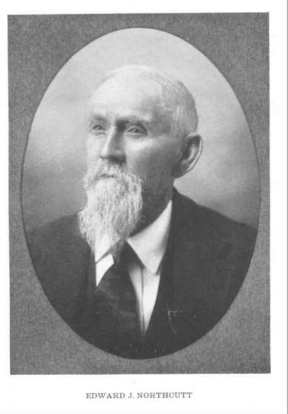
In 1852 the mining town of Althouse was established as a trading post by A. G. WALLING, E. J. NORTHCUTT, and B. J. BELL. A few years later Edward established a store and hotel in Deer Creek Valley. The business was operated as "E. J. Northcutt and Brothers" (Edward, Shadrach, and William). Salathiel was employed there.


k.jpg)
.jpg)
.jpg)
a.jpg)
b.jpg)
c.jpg)
d.jpg)
e.jpg)
f.jpg)
g.jpg)
h.jpg)
l.jpg)
m.jpg)

