25 December 2012

The 25 Days of Christmas

This is a recap of my 25 Days of Christmas posts, beginning on December first,

Each morning I have been posting a Bible verse and a few thoughts to my Facebook Status. I have really enjoyed doing this and I thought I would share the entire 25 Days with you.
Note: Bible references are from the New American Standard Bible (NASB).

Dec 1


Therefore the Lord Himself will give you a sign: Behold, a virgin will be with child and bear a son, and she will call His name Immanuel. 
~Isaiah 7:14
The greatest Christmas gift of all was never placed beneath a tree,
But lay within a manger beneath a star, for all to see!
Dec 2

The angel said to her, "Do not be afraid, Mary; for you have found favor with God. And behold, you will conceive in your womb and bear a son, and you shall name Him Jesus.
~Luke 1:30-31
Remember, Jesus is the Reason for the Season!
Dec 3

But when the fullness of the time came, God sent forth His Son, born of a woman, born under the Law, so that He might redeem those who were under the Law, that we might receive the adoption as sons.
~Galatians 4:4-5
Don't forget, God wants to be a part of your Christmas!
Dec 4

(An) angel of the Lord appeared to him in a dream, saying, "Joseph, son of David, do not be afraid to take Mary as your wife; for the Child who has been conceived in her is of the Holy Spirit. She will bear a Son; and you shall call His name Jesus, for He will save His people from their sins."
~Matthew 1:20-21
I'm just a sinner saved by grace. What a great gift I've been given!
Dec 5:

For a child will be born to us, a son will be given to us;
And the government will rest on His shoulders;
And His name will be called Wonderful Counselor, Mighty God,
Eternal Father, Prince of Peace.
~Isaiah 9:6
This baby, this GIFT from God, was not your typical child. He was, and is, special. Don't refuse this gift.
Dec 6

Now all this took place to fulfill what was spoken by the Lord through the prophet: "Behold, the virgin shall be with child and shall bear a Son, and they shall call His name Immanuel," which translated means, "God with us."
~Matthew 1:22-23
God wants to be "with us" not only at Christmas time, but all through the year.
Dec 7:

While they were there, the days were completed for her to give birth. And she gave birth to her firstborn son; and she wrapped Him in cloths, and laid Him in a manger, because there was no room for them in the inn.
~Luke 2:6-7
Could Mary have known this little Baby she held in her arms was the Lord of creation and would one day be the Savior of mankind.
Dec 8:

But the angel said to them, "Do not be afraid; for behold, I bring you good news of great joy which will be for all the people;
~Luke 2:10
Even with all the bad news in the world today, there is GOOD NEWS which will bring joy to everyone!
Dec 9

Joseph also went up from Galilee, from the city of Nazareth, to Judea, to the city of David which is called Bethlehem, because he was of the house and family of David, in order to register along with Mary, who was engaged to him, and was with child.
~Luke 2:4-5
Bethlehem ("House of Meat/Bread") was the ancestral home of King David. Jesus, born in Bethlehem, was the Bread of God. He was the "living bread that came down out of heaven." (John 6:51)
Dec 10

"for today in the city of David there has been born for you a Savior, who is Christ the Lord. This will be a sign for you: you will find a baby wrapped in cloths and lying in a manger."
~Luke 2:11-12
Jesus was the FIRST Christmas Gift -- a gift from God. And yes, this Gift was wrapped, with love. When you see the gifts under the tree. Remember, they are wrapped with love.
Dec 11

And suddenly there appeared with the angel a multitude of the heavenly host praising God and saying,
"Glory to God in the highest,
And on earth peace among men with whom He is pleased."
~Luke 2:13-14
As we prepare to celebrate, the birth of our Lord, let us always remember why He came. And as we present our gifts to our friends and all our loved ones, let us offer Him the holy gift of praise.
Dec 12

For the wages of sin is death, but the free gift of God is eternal life in Christ Jesus our Lord.
~Romans 6:23
Yes, Jesus was a Gift from God, but the true gift is the salvation we receive when when accept Jesus as our Lord and Savior. "For by grace you have been saved through faith; and that not of yourselves, it is the gift of God." (Ephesians 2:8)
Dec 13

Every good thing given and every perfect gift is from above, coming down from the Father of lights, with whom there is no variation or shifting shadow.
~James 1:17
God loves giving gifts all year long, why shouldn't we? Maybe we should have Christmas all year long! I love everything about Christmas. Just think, even Christmas lights declare to glory of God, the Father of lights!
Dec 14

And the testimony is this, that God has given us eternal life, and this life is in His Son. He who has the Son has the life; he who does not have the Son of God does not have the life.
~1 John 5:11-12
Even the best gift, if left unwrapped under the tree, it worthless. Open your heart and accept the gift God has given to you--eternal life through Jesus Christ, His Son. 
Dec 15

For by grace you have been saved through faith; and that not of yourselves, it is the gift of God; not as a result of works, so that no one may boast.
~Ephesians 2:8-9
Unwrapping a package you bought and wrapped yourself is meaningless. There is no joy or excitement.
There is nothing you can do to earn salvation. You can't buy it, it is the GIFT of God.
Dec 16

And it came to pass, as the angels were gone away from them into heaven, the shepherds said one to another, Let us now go even unto Bethlehem, and see this thing which is come to pass, which the Lord hath made known unto us.
~Luke 2:15-16
Why were shepherds the first, and one of only two groups of people to visit Jesus as a baby? Shepherds were one of the lowliest occupations, yet the Lord himself was a shepherd (Psalm 23). Jesus said: "I am the good shepherd: the good shepherd giveth his life for the sheep." (John 10:11) 
Dec 17
Now after Jesus was born in Bethlehem of Judea in the days of Herod the king, magi from the east arrived in Jerusalem, saying, "Where is He who has been born King of the Jews? For we saw His star in the east and have come to worship Him."
~Matthew 2:1-2
The shepherds (see yesterday) and the maji (or "wise men") were the only two groups of people who visited the baby Jesus. The shepherds believed the what the angels said; the maji believed what the Scriptures said and traveled several hundred miles to worship the newborn King.
We should ALL believe the Word of God. Worship Christ Jesus, not simply as a baby born in Bethlehem, but as King and Lord. (see Romans 14:11)
Dec 18

After hearing the king, they went their way; and the star, which they had seen in the east, went on before them until it came and stood over the place where the Child was. When they saw the star, they rejoiced exceedingly with great joy.
~Matthew 2:9-10
God promises that if you seek Him, you will find Him. (Deut 4:29, Prov 8:17) No matter what you find under the tree this Christmas, nothing will give you more joy than finding Christ and allowing Him to be the Lord of your life.
Dec 19

So [the shepherds] came in a hurry and found their way to Mary and Joseph, and the baby as He lay in the manger. When they had seen this, they made known the statement which had been told them about this Child.
~Luke 2:16-17
The shepherds did not keep the good news to themselves and neither should you. Share the joy of Christmas with everyone you meet!
Go, tell it on the mountain,
Over the hills and everywhere;
Go, tell it on the mountain,
That Jesus Christ is born.
Dec 20

And all who heard it wondered at the things which were told them by the shepherds. But Mary treasured all these things, pondering them in her heart.
~Luke 2:18-19
Think about what Mary had gone through: an angel told her she would be the mother of Jesus; a 90 mile trip, at 9 months pregnant, to Bethlehem; giving birth in a stable; a visit from some shepherds. Now, as she watched her baby sleeping in a manger, Mary could DO nothing, but she did TREASURE and PONDER all that had happened.
As we celebrate this Christmas, let us treasure and ponder all that God did for us 2,000 years ago.
TREASURE: 1. to collect and store up (something of value) for future use : hoard; 2. to hold or keep as precious : cherish, prize.
PONDER: 1. to weigh in the mind : appraise; 2. to think about : reflect on.
Dec 21

[Jesus prayed] "Father, the hour has come; glorify Your Son, that the Son may glorify You, ... that to all whom You have given Him, He may give eternal life. This is eternal life, that they may know You, the only true God, and Jesus Christ whom You have sent.
~John 17:1-3
This was the beginning of Jesus' prayer before before being betrayed and crucified.
The only reason Jesus, the Son of God, came to earth was to die for our sins, giving eternal life to all who come to Him. (John 3:16, 6:40; 1 John 5:11; Romans 6:23)
Dec 22

After coming into the house they saw the Child with Mary His mother; and they fell to the ground and worshiped Him. Then, opening their treasures, they presented to Him gifts of gold, frankincense, and myrrh.
~Matthew 2:11
The maji presented three gifts. The value of gold is obvious, but what about frankincense and myrrh? In ancient times, frankincense and myrrh were commonly used together to relieve postpartum pain and anxiety, lessen postpartum depression, and reduce bleeding after delivery. Whatever was left over could be burned as incense.
The wise men traveled about 800 from Persia to Jerusalem searching for the newborn king. Camels can travel about 20 miles a day, but allowing only 10 miles a day they would have made their journey in about 80 days (or as little as 40 days). The gifts of frankincense and myrrh were very practical gifts for a new mother and her child.
Dec 23

By this the love of God was manifested in us, that God has sent His only begotten Son into the world so that we might live through Him.
~John 4:9
When I was young and didn't know what to get as a gift for someone, my parents would say "pick something you would like to receive." Have you ever purchased a gift for someone because it is something you would like to receive? Have you ever received a gift you really like, then turned around and given it to someone else who is less fortunate than you? It can be very hard to give away something the really like, want, need, etc.
God gave us the gift of his Son, his ONLY Son. Why? Because we (mankind) needed Him. We were sinners, and only by sending His Son to die for us could we received the ultimate gift of eternal life through Jesus Christ.
Dec 24 (Christmas Eve!)

Thanks be to God for His indescribable gift!
~2 Corinthians 9:15

I remember singing this song as a child:
Thank you, Lord, for saving my soul.
Thank you, Lord, for making me whole.
Thank you, Lord, for giving to me.
Thy great salvation so rich and free.
There are no words to describe what God has given us. Whether it is friends and family, financial blessings, or even talents, it is impossible to properly express our gratitude in words. "Thank You, God" just doesn't seem enough! When it comes to the gift of His Son, I can only bow on my knees and cry "Holy is the Lord!"

Dec 25 (Christmas Day!)

For God so loved the world, that He gave His only begotten Son, that whoever believes in Him shall not perish, but have eternal life.
~John 3:16

We celebrate Christmas because God sent His Son, Jesus, as a little baby. But God was actually looking ahead in time to when His Son would died for the sins of the world. God's love for us was so great He was willing to give His Son.
Let us all rejoice this Christmas! Jesus, born of a virgin, died on a cross so we could live with Him forever.

01 December 2012

Yours, Mine, and Ours - an 1850 blended family


Starting in 1850, the U. S. Census recorded the names of every person in each household. However, from 1850 to 1870 there was no indication of family relationships (i.e., wife, son, daughter, etc.). Therefore information about family makeup taken from these early census records cannot always be taken at face value.

Look at this example taken from the 1850 census of Long Creek, Carroll County, Arkansas. (Note: Elizabeth, is my 3d great-grandaunt, sister of my 3d great-grandmother, Margaret GOLDEN GRAHAM.)
  •  John MAY, age 50 (abt 1800)
  • Elizabeth MAY, age 25 (abt 1825)
  • Catherine MAY, age 14 (abt 1836)
  • John MAY, age 12 (abt 1838)
  • Nancy MAY, age 9 (abt 1841)
  • Houston MAY, age 7 (abt 1843)
  • William MAY, age 3 (abt 1847)
  • Martha J MAY, age 0 (abt 1850)
There are two adults and six children, all with the same last name and at first glance it appears to be a “normal” family. But notice Elizabeth is 25 years younger than John, and Catherine is 11 years younger than Elizabeth. Two, of many possibilities, are:
John’s wife may have recently died (note Martha’s age) leaving him to care for the children. Elizabeth may be the oldest child and the next several children between her and Catherine (if any) have either died or married/moved away).

Or, John's first wife died several years ago and he married a much younger Elizabeth who bore some of the younger children.

There are any number of possibilities, however the correct one is:
John’s first wife (name unknown) had Catherine and John (and perhaps more children). His wife died sometime between 1838 and 1846, when John married Elizabeth. However, Elizabeth was the widow of William PHARRIS who died in 1844, leaving Elizabeth with two children: Nancy E PHARRIS, born 1841, and Doctor Houston, born 1843. John and Elizabeth were married in 1846 and had two more children, William in 1847 and Martha Jane in 1850.

If the census taker had correctly recorded the names, there would be no confusion. Chances are he asked for the children's names and assumed they were all John's children.

Moral of this story: Don't rush to create a family where there already are three.

10 June 2012

David Conger ABBOTT was a Wheelright, Carriage-Maker, and Wharfinger, but was he a Minister?


David Conger Abbott
I have always heard that my great-great-great grandfather, David Conger ABBOTT, was a Baptist minister in Bakersfield, California. I even have a picture of him standing at a pulpit.

I have been researching for forty years and have found some interesting pieces of information about D. C. ABBOTT, but I've never found "proof" that he was (or was not) a minister. And to me, the lack of evidence does not necessarily disprove a theory, it just leaves it as a possibility.

I recently came upon a piece of evidence which indicates he indeed may have been a minister. Along the way, I've uncovered some additional information, like two short-lived marriages, and a brief stint as a collector, or wharfinger, on the wharves of San Francisco.
 Here is a brief summary of the life of David Conger ABBOTT:

  • David was born in Morristown, Morris County, New Jersey, on 9 Jun 1836. He was the ninth of eleven children born to Abijah ABBOTT and Elizabeth CONGER.
  • He left home at age 17 (about 1853) and moved to Ohio where he mastered the wheelright trade (wheel/wagon making), learning from his older brother Ira, who was a carriage maker in Reynoldsburg.
  • About 1857 Ira moved his family to Mahomet, Champaign County, Illinois; however, David chose to continue west. He settled in Oroville, Butte County, California, where he set up business as a carriage and wagon maker.
  • It was in Oroville, in 1861, that he married Mary Thomasita ESCUDARO, born in Jalisco, Mexico. (According to a researcher from Mexico, her name was probably Maria Tomasa ESCUDERO). She was the daughter of a Doctor ESCUDARO (ESCUDERO).
  • About 1866, David and Mary moved to Santa Clara County, where he established a carriage and wagon business in the town of  Santa Clara. It was here Mary died in 1879, leaving David to care for their eight surviving children. Their children were:
    1. Clara S. (b. c1863) who married Tom MOAR in 1882.
    2. Abijah A. (b. c1864)
    3. Florence M. (b. c1865) who died in 1880 and is buried near her mother at Mission Park Memorial Park, in Santa Clara.
    4. William K. (b. c1867)
    5. Mary "Minnie" T. (b. 8 Apr 1869) who later married John Franklin WALTON. Her son, Jim H. WALTON, insisted her name was Mignonette "Minnie" Thomasine.
    6. David A. (b. Dec 1869) who died 6 Sep 1891.
    7. a daughter (b. 17 Nov 1872) who died 11 Dec 1872
    8. Reed Wilson (b. 30 May 1875) who died 31 May 1907.
    9. Vida S. (b. abt 1878) who married J. S. PFEIFFER and died Jan 1907.
  • It appears David may not have been making enough money in Santa Clara, as in 1880 he took a position as "collector" or "wharfinger" on the wharf in San Francisco (50 miles to the north). In 1880 he was staying in the International Hotel, at 848 Kearny. He worked in San Francisco until 1883, living at 116 Eleventh (1881), 217 Eighth (1882), 1017 Folsom (1883).
  • Sometime after Aug 1880, David is supposed to have married Mary "Minnie" A. SCHIEBER. All I know about her is she was born in France. I have found no evidence of this marriage. There is also a report that he had a child by Minnie named Elijah, but no Elijah has been found (yet).
  • On 8 Jun 1882, in San Francisco, he married Mrs. Mary A. RICHMOND. (Her maiden name may have been SCHIEBER and Minnie is a common nickname for Mary.) The 27 Jun 1882 issue of the Daily Alta California newspaper contained the following notice on page 2:
    MARRIED.
    San Francisco, June 8–Rev. D. C. Abbot to Mrs M. A. Richmond.
    This is the first and, so far, only mention that he was a minister.

  • The marriage between David and Minnie did not last long. On 14 Aug 1882 the Daily Alta California contained the following notice on page 2:
  • NOTICE IS HEREBY GIVEN THAT MY WIFE, MARY A. ABBOTT, having left my bed and board without cause or provocation, I will pay no debts of her contracting. San Francisco, August 9th 1882.
    (Signed)                 D. C. ABBOTT.
    The 27 Sep 1883 issue of the (San Francisco) Evening Bulletin contained a notice that "Judge Sullivan has granted David C. Abbott a divorce from Mary A. Abbott on the ground of desertion." 
  • After leaving his job in San Francisco he moved back to Santa Clara County, living in San Jose. On 25 Feb 1885, in San Jose, David married a nurse named Katherine "Kate" KLINE. The 28 Feb 1885 issue of the San Jose City Item contained the following notice:
    Marriage certificates Filed During the Week.
    D C. Abbott, aged 48 and Kate Kline, aged 48, both of San Jose.
    Again, this was a short lived marriage.
  • David owned Abbott Carriage Factory in Santa Clara until 1886, when he moved Delano, about 30 miles north of Bakersfield, in Kern County. Apparently he was unable to persuade Kate to move to Delano with him and in 1888 he filed for divorce. The newspaper article in the 7 Apr 1888 issue of the San Jose Daily News is long, but interesting:
    A SUIT FOR DIVORCE
    HUSBAND SAYS HE CANNOT PAY ALIMONY
        The divorce suit of D. C. Abbott against his wife, Kate Abbott, transferred from Kern County, came up before Judge Spencer yesterday on defendant's motion for alimony. A physician's certificate was presented to the effect that Mrs Abbott was too ill to attend and a continuance on that ground was asked. The plaintiff wanted the case to proceed owing to heavy expenses incurred in waiting, and Judge Spencer decided to hear the petition as far as possible in the absence of Mrs. Abbott.
        The complaint alleged desertion and cruelty as grounds for divorce; the alleged cruelty consisting in the abuse of one of Abbott's children by a former wife; and the defence consisted of denials and a cross complaint where in (sic) defendant alleged desertion. Mrs. Abbott's affidavit in support of her claim for alimony set forth that the parties were married in San Jose, February 25th, 1885; that prior to March 1st, 1887, plaintiff without cause of explanation deserted and has since continued to reside apart from her without making any provisions for her support; that she is in poor health and without means; that plaintiff is a skillful mechanic, proprietor of a carriage factory in Kern county, with a prosperous business, the owner of more than 200 acres of valuable land and at least $1,000 worth of personal property. She prays for $25 per month, $75 for expenses and $100 for counsel fees.
        Mr. Abbott testified that he was worth $1,200 or $1,500 when he married, that he tried for six months to induce his wife to go to Delano, Kern county, but she refused. At Delano he owned a lot with cheap improvements assessed at $700 or $800, mortgaged for $500, and he was unable to pay the interest; was indebted in large sums to various parties, had himself and four children to support and his shop had not paid expenses for nine months past. He had borrowed money to commence this suit and to come to San Jose, and if the court ordered the alimony paid he would have to borrow again. The case was continued.
    I have not yet obtained the final decree of the divorce.
  • At the 1892 Fifteenth Agricultural District Exhibition, D. C. Abbott, of Delano, exhibited a "Roadster" horse, named "Delano Chief, by Solano Chief; dam Nellie A." He received a second place award of $10 for the District (Kern and Tulare Counties).
  • The 1900 census of Kern County listed David C. ABBOTT, age 64, widowed. He was a wheelwright, owned his home, and was living with his son, Reed W. ABBOTT, age 25, who was a blacksmith.
  • D. C. ABBOTT, carriage maker, died at the Bakersfield Sanitorium on 6 Jul 1907, at the age of 72. According to his death certificate he was married. Perhaps the informant, his daughter Minnie WALTON, meant he "had been" married... several times.
The research continues...

02 June 2012

Jerome BENSON and the Settlement of San Bernardino

My 4th great-grandfather, Jerome Messenger BENSON, was born in 1810 in Fabius, Onandago County, New York. He was an early member of the Mormon Church, being among the members kicked out of Missouri in 1838.

In 1852, he lead a cowteam from Council Bluffs, Iowa, to the Great Salt Lake Valley, Utah. He was one of the first settlers of Springville and by Dec 1852 was a member of the Provo, Utah, First Ward. In Jun 1853, his wife Mary "Polly" drowned trying to cross the Jordan River. She is buried in the Provo City Cemetery.
In early June 1851, a group of 500 Mormons, in a 150-wagon caravan from Utah, had arrived near Cajon Pass, north of San Bernardino. After negotiating the purchase of the 37,000 acre Rancho San Bernardino for $77,000, they began building and planting. Fort San Bernardino (often called "Mormon Stockade") was built on eight acres at the center of their settlement. It is at the site of the present county courthouse.

In 1853, San Bernardino County was formed from Los Angeles County. The same year, the city of San Bernardino was laid out one mile square, using the current street grid system, which is based upon the grid layout of Salt Lake City.
By 1855, Jerome Messenger BENSON had left the church and as an "apostate"  left Provo, Utah, and headed for California. On Monday, 11 Sep 1855, he and another traveler stopped at the Mormon settlement at Las Vegas, Nevada, to do some "cattle trading."

Jerome was mentioned in a letter dated 11 Sep 1855 from Mormon Elder George W. Bean to Thomas Bullock.
11 Sep The monotony of our life is occasionally enlivened by a straggling party of gentiles and apostate ‘Mormons’ passing by in search of golden salvation!!! Jerome M Benson of Jordan bridge notoriety, and a man named Tidero, from Provo, are here at present on their way to the land of pleasant dreams.
Upon arrival in California, BENSON settled about five miles from the Mormon town of San Bernardino, on what he thought was government land and outside the rancho. About 1856-57, there were questions about land boundaries and some properties were claimed by "outsiders." When asked to moved, Jerome refused, and when the court decided against him, he and friends fortified his adobe home with an old brass cannon and challenged anyone to dislodge him. Nothing further came of the incident. (The site of "Fort Benson" is present day 10600 Hunts Lane, Colton, California.)

In Oct 1857, the Mormon church recalled the settlers in San Bernardino and over half of the members left, literally giving away their land and property. Those who remained lacked organization and resources and the city disincorporated.

On 27 Feb 1863, the Daily Alta California reported:
Mr. Allen introduced, in the Assembly, a bill to authorize Jerome M. Benson and Samuel Pine to construct a wagon road in San Bernardino county, from the mouth of Big Creek Cañon, through the cañon and over the San Bernardino range to Little Bear Valley.
On 28 Mar 1863, the California State Legislature approved the bill, authorizing the Jerome and Samuel (his second wife's brother) "to construct a wagon road, not to exceed eighty feet in width, in San Bernardino County, from the mouth of City Creek Cañon, then up said cañon, and across the Sierra Nevada range of mountains to Little Bear Valley."

By 1870, Jerome and Jane and their family were living just south–across the county line in the San Jacinto District of San Diego County. Jerome died 17 Apr 1877, and his will, written 25 Mar 1877, was probated 30 Mar 1878 in San Diego County.

27 September 2010

My Uncle - Mountain Man, Indian Interpreter, Barber, Dentist


The 25 May 1859 issue of The Deseret News, contained the following marriage notice:
At American Fork, Utah county, on the 27th ult., by Bishop L. E. Harrington. Mr. JOSEPH A. GEBOW, Indian Interpreter, G. S. L. City, and Miss PRUSSIA P. WALTON, of Provo.

NOTE: Prussia was the daughter of Alfred WALTON,
my 4th great grandfather.

Joseph A. GIBAULT was born about 1822 in Canada. The parish register of l'Assomption Paroisse (Assumption Parish) St. Pierre du Portage, in the District of Montreal, Quebec, records the baptism of Joseph Amable GIBAULT who was born 12 Apr 1822 and baptized 13 Apr 1822. It is possible this was the same person.
    (French)
Le treize Avril de l'an mil huit cent vingt deux par nous Toussigne Prêtse a été baptisé Joseph Amable née hier du legitime mariage de Jean Baptist Gibault cultivateur de calla Paroisse St de Maria Louisa Rachel Evans, Parrain st Amable Archambault, marreine dame Catherine Josepha Louisa Degoine que ont signé avec nous le pere á ont déclaré ne scavoir signer.
                    Amable Archambault, Jos deBelleville
(English-a poor translation)
The thirteenth of April one thousand eight hundred twenty two by us all signed Priest was baptised Joseph Amable born yesterday of the legitimate marriage of Jean Baptist Gibault, farmer of "calla" from St Maria Parish, Louisa Rachel Evans, Patron St Amable Archambault, godmother Lady Catherine Louisa Josepha Degoine that we have signed with the father has said they know how to sign.
                    Amable Archambault, Jos deBelleville
          

By 1845 he was living among the Indians in the mountains (presumably the Rocky Mountains). He was the interpreter for Dr. Jacob Forney, Superintendent of Indian Affairs for Utah Territory.

In 1858 he was living in Great Salt Lake City, Utah Territory, where he began teaching a class on "The Snake or Shosone Dialect." In 1859 he published a booket called A Vocabulary of the Snake or Shoshone Dialect.

It appears, at least for a time, he became a Mormon, and on 27 Apr 1859, he married Prussia P. WALTON, who was born 24 Aug 1841 in Plymouth, Richland County, Ohio. (Prussia was the daughter of Alfred WALTON, an Elder in the church.) On 25 Sep 1859, Joseph advertised the opening of his "Indian School at Wardle's Hall in the 16th Ward." Cost was 25¢ per lesson.

Joseph and Prussia GIBAULT were listed in the 1860 census, living in the 9th Ward, Great Salt Lake City.
    21 Jul 1860
Jos A. GIBAULT, age 38, indian interpreter, born in Canada
Prussia GIBAULT, age 18, born in Pennsylvania

No further record of Prussia has been found and she may have died soon after, as Joseph married Pooewet, an Indian, and about 1861 had a daughter named "Bruzasly".

On 17 Sep 1864, The Deseret News reported:
JOSEPH A. GEBOW, was arrested on the 1st inst., charged with giving whisky to Indians. The case being a plain one, Gebow begged for mercy, promised reformation of character, which there is plenty of room for, and then allowed judgment to be entered pro confesso. Fined $30.
The 21 Sep 1864 issue of The Deseret News reported:
Jesse Ewbanks was brought before Alderman Clinton on Thursday last, charged with insulting the wife of Joseph A. Gebow. The defendent brought witnesses to prov that the house of Gebow was generally known as a house of ill fame, and that such propositions as were made by Ewbanks were of common occurance.
Joseph left Utah and moved to Wyoming Territory about 1865. The 11 Jan 1865 issue of The Deseret News contained a list of unclaimed letters at the Post Office, including one for Joseph A. GEBOW. Joseph and Pooewet had a second daughter, Josephine, born about 1866 in Wyoming Territory.

The 1870 census listed them living in Green River, Sweetwater County, Wyoming Territory.
    27 Jun 1870
Joseph A. GEBOW, age 48, barber, born in Canada
Pooewet GEBOW, age 35, Indian, born in Wyoming
Brazasly GEBOW, age 9, Indian, born in Wyoming
Josephine GEBOW, age 4, Indian, born in Wyoming
A sermon by Bishop Wooley, given sometime in the 1860s or early 1870s and published 1875 in Mormon Expositor, contained a reference to Joseph GEBOW who appears to be an excommunicated Mormon.
Our streets are filled with whores, thieves, gamblers, pimps, etc. The only way to purify it is to drive them out. Tear down their houses and send them where Gebow and his gang (looking toward the camp) went. That Gebow was a Mormon–Brother Gebow–was a Mormon once (laughter); but it is true though.
He moved back to Utah, living in Ogden, Weber County. He was listed in the 1879-80 Utah Directory, Odgen Business Directory, under two categories (Barbers and Dentists), as J A GEBOW, opposite Fireman's Hall.
The 1880 census listed him as a widower, living with the Alonzo and Marie Stephen family in Ogden.
       3 Jun 1880
Joseph GEBOW, age 58, barber, born in Canada
No further record has been found concerning Joseph A. GIBAULT/GEBOW

09 September 2010

The Northcutts and the Oklahoma Land Run

There were actually several land runs. For complete details of Oklahoma land settlement, visit the OKGenWeb site: http://www.okgenweb.org/~land/.

The Oklahoma "Land Runs"

1st Run: 22 Apr 1889 (Unassigned Lands)
The First Land Run opened all or part of the present Oklahoma counties of Canadian, Cleveland, Kingfisher, Logan, Oklahoma, and Payne. At noon on 22 Apr 1889, millions of acres land that was formerly Indian Territory (commonly referred to as "unassigned lands") was made available to white settlers. The land was laid out in 160-acre homesteads and could settlers could claim title to the land if they lived on the land and improved it. An estimated 50,000 people lined up on the border waiting for the noon "rush." The hopeful, by all kinds of transportation - horses, wagons, trains, bicycles or on foot) raced to claim their land. Settlers who illegally entered the territory early in order to claim the best land became known as "Sooners." By the end of the day, tent cities had sprung up from nothing at Oklahoma City, Kingfisher, El Reno, Norman, Guthrie, and Stillwater. Oklahoma City and Guthrie had populations of 10,000 after only half a day.

2nd Run: 22 Sep 1891 (Iowa, Sac and Fox, Pottawatomie, and Shawnee Lands)
In 1891, three Indian Reservations (which had been purchased from the Indians) bordering on the former "unassigned lands" were declared "surplus" and opened for settlement. About 20,000 people lined up to settle the land in Counties "A" and "B" which became Lincoln and Pottawatomie Counties.

3rd Run: 19 Apr 1892 (Cheyenne and Arapaho Land)
In 1892, 25,000 settlers "rushed" to settle land in Counties "C" (Blaine), "D" (Dewey), "E" (Day, obsolete county combined with Ellis county in 1907), "F" (Roger Mills),"G" (Custer), and "H" (Washita).

4th Run: 16 Sep 1893 (The Cherokee Outlet)
The 1893 run was the largest of the land runs. An estimated 100,000 people raced to claim land, The Cherokee Outlet was land leased by cattlemen from the Cherokee after the Civil War. The U. S. Government eventually purchased the land and allowed settlement of the area originally known as Counties K, L, M, N, O, P, and Q. It was decided that the inhabitants of each county could select the name after the run. The names selected were Kay, Grant, Woods, Woodward, Garfield, Noble, and Pawnee. (In 1907, after Oklahoma achieved statehood, the following counties were made from existing counties in the Cherokee Outlet: Alfalfa County was formed from Woods County; Ellis County from Day and Woodward Counties; Harper County from Indian Lands, Woods, and Woodward Counties; and Major County from Woods County.)

5th Run: 3 May 1895 (Kickapoo Lands)
The last, and smallest, land run in Oklahoma was the opening of 183,000 acres of Kickapoo land. The area was added to Lincoln, Oklahoma, and Pottawatomie Counties.

The NORTHCUTT Family and the Oklahoma Land Rush
Shadrach Daily NORTHCUTT was an older brother of Willis NORTHCUTT (great grandfather my wife, Judy).
Shadrach was born in Champaign County, Ohio, and moved with his family to Wapello County, Iowa, then to Harrison County, Missouri, where he married Mary Jane FALLIS on 3 Nov 1872. Four children were born in Missouri and in 1882, they moved to Stafford County, Kansas, where they had four more children and lived until 1893.

In 1893, Shadrach made the land run into the Cherokee Outlet. He staked his claim to the South West Quarter of Section 28, Township 28 North, Range 6 West (in what is now Jarvis Township, Grant County), approximately 5 miles northwest of Wakita, and rode 80 miles to Kingfisher to file the claim.

His name is inscribed on the Homesteaders Memorial, located at the County Courthouse in Medford, Grant County, Oklahoma. The monument reads:
To the homesteaders and early settlers of Grant County this monument is gratefully dedicated. In recognition of their courage in the face of untold hardships the descendants sincerely acknowledge their sense of obligation.
These early Grant County settlers were among some 100,000 who lined up September 16, 1893 to race for a 160 acre claim. The homesteads scattered throughout an area comprising six million acres. The award went to the first person arriving, planting their stake and duly registering their location at the land office.
Others while not actually making the run acquired the land at an early date, either by purchase or barter, lived on it and raise their families and together with the homesteaders became the early pioneer settlers of Grant County, laying the foundation for our modern society.
The family, including seven children, settled on the claim. They lived in a small sod house, complimented by a large white tent. According to Mary's diary, they arrived "with our stock, goods, chattels, twelve head of horses, four cows, no money, no house, no fence, and no fuel except surface coal (cow chips)."

Ten years later, on 17 Aug 1903, Shadrach recieved the homestead certificate for his land. In 1907, the sod house was replaced with a two-story frame house, only a few months before Shadrach died. He died 19 Dec 1907 in Grant County.

Two of Shadrach's brothers later moved to Oklahoma, Jesse (1841-1917) and Willis (1854-1940), settling in Grant County.

07 September 2010

Beer Barrel Polka

One of the first songs I learned to play on the accordion was "Beer Barrel Polka." The song, often called "Roll Out The Barrel," was composed by Czech musician, Jaromír Vejvoda in 1927 and was originally written as music only. The lyrics were added in 1934 by Václav Zeman and the song was known as "Škoda lásky" ("Wasted Love").

Will Glahé and his Glahé Musette Orchestra recorded the German version in 1934 and in 1939, recorded an English version, Beer Barrel Polka, with lyrics by Lew Brown and Wladimir Timm. The Andrews Sisters recorded the song that same year.

During World War II, the song became immensely popular with soldiers on both sides.
LYRICS
Common Version
There's a garden, what a garden,
Only happy faces bloom there
And there's never any room there
For a worry or a gloom there.
Oh there's music and there's dancing
And a lot of sweet romancing
When they play a polka
They all get in the swing.

Every time they hear that oom-pa-pa
Everybody feels so tra-la-la
They want to throw their cares away
They all go lah-de-ah-de-ay,
Then they hear a rumble on the floor
It's the big surprise they're waiting for
And all the couples form a ring,
For miles around you'll hear them sing:

Chorus:
Roll out the barrel, we'll have a barrel of fun.
Roll out the barrel, we've got the blues on the run.
Zing! Boom! Ta-ra-rel,
     ring out a song of good cheer!
Now's the time to roll the barrel,
For the gang's all here.
1939 Andrews Sisters Version
There's a garden, what a garden,
Only happy faces bloom there
And there's never any room there
For a worry or a gloom there.
Oh there's music and there's dancing
And a lot of sweet romancing
When they play the polka
They all get in the swing.

Every time they hear that oom-pa-pa
Everybody feels so tra-la-la
They want to throw their cares away
They all go lah-de-ah-de-ay,
Then they hear a rumble on the floor, the floor,
It's a big surprise they're waiting for
And all the couples form a ring,
For miles around you'll hear them sing:

Chorus:
Roll out the barrel, we'll have a barrel of fun.
Roll out the barrel, we've got the blues on the run.
Zing! Boom! Ta-rar-rel,
     ring out a song of good cheer!
Now's the time to roll the barrel,
for the gang's all here.

Da-da-da-da, da-da-da-da, da-da-da-da-da-da-da-da

Then they hear a rumble on the floor-or-or-or
It's a big surprise they're waiting for,
And all the couples they form a ring
For miles around you'll hear them sing

Zing do da do ding do da-do-do-day

----- instrumental break -----

Roll it out, roll it out, roll out the barrel.
Dump-dump-da da-da da-dat en da-da-da-da-da.
Sing a song of good cheer,
'Cause the whole gang is here.
Roll it out, roll it out,
Let's do the beer barrel polka.

Here is the 1939 version by the Andrews Sisters.


This version is by Canada's Polka King, Walter Ostanek And His Band (recorded in 1994). They sing the chorus but only play the verse.

28 August 2010

The Northcutts and the Rogue River Indian Wars

Settlement of  Oregon
In 1834, to encourage settlement of western lands, the U. S. Government passed the Indian Intercourse Act, which provided "the United States shall make indemnification out of the Treasury for property taken or destroyed in certain cases by Indians treaspassing on white men." Between 1840 and 1850, over 11,000 settlers traveled the Oregon Trail.


The Rogue River Indian Wars
During the late 1840s and early 1850s, there were a several "wars" between the native Indians and the settlers. From 1855-1856, there was a major outbreak of violence known as the Rouge River War. (The Rogue River is located in southern Oregon near.)

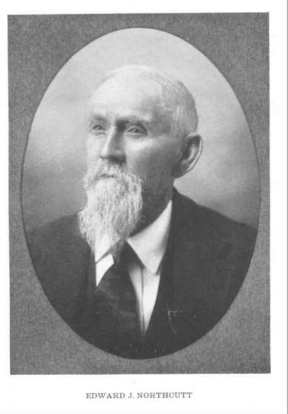
Three brothers owned a store and hotel in Deer Creek Valley, in Josephine County, Oregon. The firm, E. J. Northcutt and Brothers, was owned by Edward J., Shadrach D., and William W. NORTHCUTT. A fourth brother , Salathiel T., worked at the store but was not an owner. In the early morning hours on 24 Oct 1855, the Northcutt home and business was attacked. Their house and property were destroyed or carried off by Indians; an accounting of lost property included:
40 lbs butter, worth, per pound, 75 cents ($30), 50 lbs bacon, worth, per pound, 40 cents ($20), 40,000 lbs potatoes, worth, 8 cents ($3,900), 3,000 pieces of board, per M pieces, $150 ($150), 50 hogs, each worth $15 ($750), 2 American horses, each $280 ($560), 2 yoke oxen, each worth $250 ($500), and 1 building, store and hotel ($1,000). The total loss was $6,100.
By 1880, Edward had moved to Idaho, William had returned east, to Missouri, and Shadrach and Salathiel had moved north to  Salem, Marion County, Oregon. In Jul 1880, Shadrach, the only brother from the firm of E. J. Northcutt and Brothers remaining in Oregon, filed a claim for compensation from the 1855 Indian raid under the Indian Intercourse Act of 1834. Although the act had been repealed in 1859, claims could still be filed for earlier actions.

It took eight years for the government to process the claim, but in 1888 the claim, reduced to $5,450, was finally approved.

NORTHCUTT FAMILY IN OREGON
The four Northcutt brothers were sons of Willis NORTHCUTT, a brother of Jeptha NORTHCUTT (great-great grandfather of my wife, Judy).
Willis was born between 1805-1810 in Champaign County, Ohio. On 24 Jan 1828, in Clark County, Ohio, he married Sarah (Sally) TURMAN. Willis and Sarah had six children in Ohio: Margaret (1828), a infant son who died young (c1829), Edward J. (1830), Shadrach D. (1832), William W. (1835), and Salathiel T. (1836).

In 1839, Willis and Sarah left their home in Champaign County, Ohio, and moved to Sagamon County, Illinois, where their last two children were born: Mary Elizabeth (1839), and Harriet M. (1841).


Apparantly Willis and Sarah were divorced, as Willis married, 18 May 1847, in Sagamon County, Emily GREEN(E). Sarah also remarried 3 Sep 1847, (probably in Sagamon County), Samuel SMITH. Sarah had a daughter, Clarinda M. SMITH (1851).


In 1851, Willis NORTHCUTT moved to Oregon Territory. Once in Oregon, Willis lived alone in northern Oregon; first in Benton County, then Yamhill County, then Polk County. On 8 May 1851, Willis NORTHCUTT wrote a letter to his brother, Jeptha, who was living in Westville, Champaign County, Ohio. Willis wrote from Council Bluffs, Iowa, which he described as "the extreme end of the United States." (This letter was taken from Pat N. Stephen's web site. Used by permission.)
Jeptha Northcutt, Champaign County, Westville, Ohio

Cainsville, "Jocuay" seven miles above Council Bluff
May 8, 1851
Brother in my last letter I in form you that I was on my way to Oregon. We have arrived at the extreme end of the United States nothing but the Missouri River to cross and we enter an indian possessions an they are very hostile and have assembled 500 "braves" to dispute our passage or to pay tribute for passing "through" there country that we will pay in powder and lead or with our blood on Monday next We intend to cross the river or "dyi" we are at this moment mustering our strength which will not exceed 75------men a small force to repel so many "Sarcys-Sarcigs???" I have no doubt there willl be a severe battle for all are "resolved" to go through and will or they must bury us all well Thank God excuse my halt as I am riting they have appointed me to the "command" thirty "Mannert-warrants" at I am in form give my love to father and mother an all in "grieving family" 
Yours in hast
Jeptha Northcutt Willis Northcutt 
" " indicates a difficult word to read. Guess has been made 
-----indicates hole in page.
No punctuation at all in letter
Transcription by Donetta Northcutt
Sarah SMITH and her younger children also moved to Oregon in 1851. Her eldest daughter, Margaret, was married and remained in Iowa. They crossed the Missouri River at Council Bluffs, Iowa, where Omaha now stands, and the first night out the Indians plundered the camp but because of the fierce resistance offered by the emigrants they got but one steer. The next day Edward, age 21, was chosen captain of the train, which he piloted through, having many trying experiences and some severe fighting with the Indians.
Sarah and her children settled in southern Oregon, living in Deer Creek Valley, in what is now Josephine County.


In 1852 the mining town of Althouse was established as a trading post by A. G. WALLING, E. J. NORTHCUTT, and B. J. BELL. A few years later Edward established a store and hotel in Deer Creek Valley. The business was operated as "E. J. Northcutt and Brothers" (Edward, Shadrach, and William). Salathiel was employed there.


24 August 2010

S.S. (RMS) Lucania - The Luxury Cruise Ship That Brought the Langen Family to America

On 11 Oct 1902, Herman LANGEN and his son, Andrew Albert LANGEN boarded the S.S. Lucania in Liverpool, England. On 12 Oct, 1902, after picking up additional passengers in Queenstown, Ireland, the ship departed, arriving in New York on 19 Oct 1902.

S. S. Lucania
The Lucania was built in 1893 by Fairfield Shipbuilding Companie in Glasgow for Liverpool to New York service. She measured 622 feet long and 65 feet 3 inches wide. Her average speed was 21 knots (max 23 knots), produced by two 5-cylinder, triple expansion engines that generated 30,000 HP. She had a crew of 415-424 and accommodation for 600 1st class, 400 2nd class and 1,000 3rd class passengers (2,000 total passengers).

S. S. Lucania, and her sister S. S. Campania (built in 1892) had rendered all other liners obsolete, setting a new standard for both spead and appearance. On her maiden voyage (2 Sep 1893) Lucania set a new record crossing from Liverpool to New York, breaking the record of Campania. The two ships continued to set new speed records until 1898, when the newly built German Kaiser Wilhelm der Grosse passed them.

First Class Smoking Room
In their day, Lucania and her sister offered the most luxurious 1st class passenger accomodation available. It was Victorian oppulence at its peak – an expression of a highly confident and prosperous age that would never be quite repeated on any other ship. All the 1st class public rooms, and the en suite staterooms of the upper deck, were generally heavily panelled, in oak, satinwood, or mahogany; and thickly carpeted. Velvet curtains hung asside the windows and portholes, while the furniture was richly upholstered in matching design. The predominant style was Art Nouveau, although other styles were also in use, such as French Renaissance, which was applied to the forward 1st class entrance hall, while the 1st class smoking room was in Elizabethan style, comprising heavy oak panels surrounding the first open fireplace ever to be used aboard a passenger liner.

First Class Dining Room
In 1901 Lucania became the first Cunard liner to be fitted with a Marconi wireless system, followed a few months later by Campania. Shortly after these installations, the two ships made history by exchanging the first wireless transmitted ice bulletin; and two years after that, Lucania made history again, this time by publishing on board newspaper based on information received by wireless telegraphy while at sea. The newspaper was called Cunard Daily Bulletin and quickly became a success.

In 1906/1907, two new Cunard ships were built, the S.S. Lucitania and the S.S. Mauretania. The Lucania voyages gradually decreased and her last voyage was 7 Jul 1909. On 14 Aug 1909 fire raged through the entire vessel. As firefighters poured water into her, she took on a list, and by the early hours of the next morning she took on a severe list. Tugs worked to right the vessel and she was taken out into the middle of the dock where she settled into the mud. She was beyond economic repair, the end had finally come. It was found that her massive engines had escaped undamaged and so, with the diginity she deserved, it was under her own steam that Lucania progressed to Ward's breakers yard in Swansea, Wales, there to be slowly cut up.

RMS (the abbreviation for Royal Mail Ship) is the prefix used for seagoing vessels that carry mail under contract to the British Royal Mail. Technically, a ship would use the prefix only while contracted to carry mail, and would revert at others times to a standard type designation, such as S.S. (steam ship). Having the title RMS was seen as a mark of quality and a competitive advantage, because the mail had to be on time.

IMAGES of S. S. LUCANIA
(click photo to enlarge)